







Protege GX DIN Rail
Single Door Controller


PRT-CTRL-DIN-1D
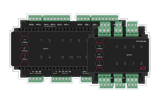
The controller is the central processing unit responsible for the control of security, access control and building automation in the Protege GX system. It communicates with all system modules, stores all configuration and transaction information, processes all system communication, and reports alarms and system activity to a monitoring station or remote computer.
- 1 door (2 readers)
- 2 multi purpose inputs
- 1 Form C relay output
Features
Integrated Access Control
Providing a highly sophisticated access control solution with large user capacity and extensive features:
- Utilize multiple access levels to manage users over scheduled periods across multiple time zones
- Assign door groups, menu groups, area groups, floor groups and elevator groups to an access level for flexible user management. Each user can be assigned multiple groups in multiple access levels
- Monitor and control users’ area status throughout the entire system with hard and soft anti-passback configuration options
- Multiple card presentation options allow the use of access control cards, tags, mobile or other credentials to arm and disarm areas associated with doors
- Count users entering an area and arm the area when the count reaches zero or deny access based on a maximum user count
Connectivity and System Expansion
Extending the Protege system with onboard local inputs and outputs allows convenient and cost effective expansion without the increased cost of modules for simple system functions:
- 2 monitored onboard inputs can each be configured for EOL (End Of Line), dual EOL, or direct contact
- 1 high current Form C relay onboard
- 1 integrated RS-485 reader port
- RS-485 connections support configuration for OSDP protocol
- System expansion is achieved seamlessly by connecting additional expander modules
Communication
RS-485 communication interface, USB port and a 10/100 ethernet communications port provide a complete solution for system communication, expansion, offsite monitoring and integration.
Secure By Design
ICT controllers are cyber secure, supporting emerging cybersecurity requirements through advanced security features. With secure encrypted communication, resilience to outages, secure storage of security parameters and no universal default passwords, ICT controllers are inherently designed to protect devices, networks and data from unauthorized access.
Mandatory cybersecurity regulations on connected devices are defining requirements in terms of data and cryptography, logical security, system management and privacy protection. ICT controllers feature essential requirements of newly introduced standards and legislation aimed at regulating the Internet of Things and IoT devices, along with specifications of emerging new laws.
Secure Encrypted Web Connection
Equipped with a factory loaded HTTPS certificate, ensuring a secure encrypted web connection straight out of the box. The default certificate provides automatic TLS encryption of data transmissions, secure identity authentication, and message signing to assure data integrity.
Flexible Reader Support
Provides 1 RS-485 reader port, allowing the connection of up to 2 readers controlling 1 door. RS-485 connections are configurable for OSDP protocol, offering additional security and adding scalability, flexibility and ease of implementation.
The ICT implementation of OSDP conforms to a subset of the OSDP functionality. For specifications and reader configuration, refer to Application Note 254: Configuring OSDP Readers, available from the ICT website.
Integrated Arming/Disarming
Featuring advanced integration of arming and disarming solutions for control of hundreds of alarm areas:
- Deny access to a user based on the status of the area and allow the user to control the area they are entering, in turn reducing false alarms
- Implement vault control areas to manage time delayed access and unlocking of vault areas in banking facilities without the need for additional hardware control devices
- Control access to a keypad using a card and PIN function, or allow card presentation to automatically log the user in at the associated keypad
- Disarm an area associated with an elevator floor on access, or prevent the user from gaining access to the floor based on the area status associated with the floor
- Arm large numbers of areas using area groups
Output Follows Input Programming
The Protege system’s advanced programming features provide endless opportunities for customized automation. Output follows input programming allows any output or output group in the system to be intelligently controlled by any input or input type. This has a wide variety of applications: from turning on lights and climate control when motion is detected, to unlocking a specific door with a key switch, or auto arming an area after a period of inactivity.
Programmable Functions
Programmable functions are special applications that implement logical control of outputs, doors, areas and other devices.
- Perform actions when a particular event or operation occurs, such as setting the room temperature based on the number of people in an area, adjusting internal lighting levels based on a sensor reading, or unlocking doors in the event of a fire alarm
- Process logic functions to allow complex equations to be evaluated using internal memory data values and output status
- Control of doors, areas, elevators and outputs can be easily programmed and managed
Integrations
The Protege controller offers integration with a wide range of third party systems:
- Link the Protege system with intelligent locking solutions through comprehensive world class solution partners Salto, Aperio, and Cencon
- High level interface for control of modern elevator systems
- Integrated biometric identification systems provide superior user identification options
- Other third party integrations such as building and lighting control systems
Multifunction Reporting Services
The controller incorporates a host of offsite reporting options.
- Implement IP based reporting using the encrypted ArmorIP protocol or other common IP reporting standards
- For complete peace of mind, set up multi-channel reporting using a combination of local ethernet and 4G network (via the Protege DIN Rail Cellular Modem)
- Communicate with third party applications using ASCII or HEX directly from the controller
Ethernet 10/100 Connection
Onboard ethernet communication allowing direct connection from a local PC or interconnection to an existing LAN/WAN:
- Directly connect the Protege system across a LAN or WAN interface for high speed upload and download
- IP reporting functionality using the ArmorIP protocol, Contact ID over IP, SIA over IP and full text reporting methods
- Full 10/100 compliant network interface allows connection of the controller to all networks at the maximum capable signaling rate
Upgradable Firmware
Firmware can be upgraded directly from the Protege GX software.
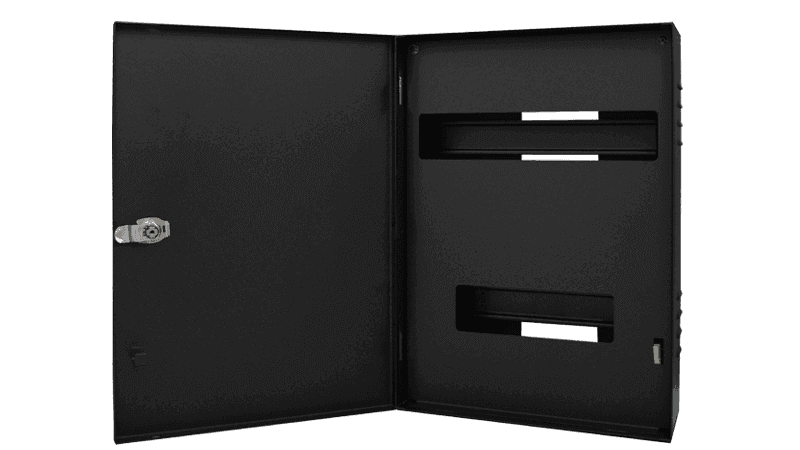
Wall Mountable
The additional wall mounting feature provides absolute convenience and flexibility in module positioning.
Specifications
| Ordering Information | |
| PRT-CTRL-DIN-1D | Protege GX DIN Rail Single Door Controller |
| Power Supply | |
| Operating Voltage | 11-14V DC |
| Operating Current | 120mA (Typical) |
| DC Output | 10.45-13.85VDC 0.7A (Typical) Electronic shutdown at 1.1A |
| Total Combined Current* | 0.82A (Max) |
| Electronic Disconnection | 9.0VDC |
| Communications | |
| Ethernet | 10/100Mbps ethernet communication link |
| RS-485 | 2 RS-485 communication interface ports - 1 for module communications, 1 for reader communications |
| USB | Type-A |
| Readers | |
| Readers | 1 RS-485 enabled reader port, allowing connection of up to 2 RS-485 capable readers providing entry/exit control for a single door |
| RS-485 reader port connections support configuration for OSDP protocol | |
| Inputs and Outputs | |
| Inputs | 2 high security monitored inputs |
| Relay Outputs | 1 Form C Relay - 7A N.O/N.C. at 30 VAC/DC resistive/inductive |
| Dimensions | |
| Dimensions (L x W x H) | 78 x 90 x 60mm (3.07 x 3.54 x 2.36") |
| Net Weight | 184.7g (6.5oz) |
| Gross Weight | 247g (8.7oz) |
| Operating Conditions | |
| Operating Temperature | -10° to 55°C (14° to 131°F) |
| Storage Temperature | -10° to 85°C (14° to 185°F) |
| Humidity | 0%-93% non-condensing, indoor use only (relative humidity) |
| MTBF | 560,421 hours (calculated using RFD 2000 (UTE C 80-810) Standard) |
Downloads
User Documentation
Firmware
Supporting Material
Certifications & Warranties
Regulatory Notices
RCM (Australian Communications and Media Authority)
This equipment carries the RCM label and complies with EMC and radio communications regulations of the Australian Communications and Media Authority (ACMA) governing the Australian and New Zealand (AS/NZS) communities.
AS/NZS 2201.1 Class 5
Protege systems conform to AS/NZS 2201.1:2007 Class 5 intruder alarm systems standards for the construction, operation, performance and installation of intruder alarm equipment and systems installed in clients' premises.
CE - Compliance with European Union (EU)
Conforms where applicable to European Union (EU) Low Voltage Directive (LVD) 2014/35/EU, Electromagnetic Compatibility (EMC) Directive 2014/30/EU, Radio Equipment Directive (RED) 2014/53/EU and RoHS Recast (RoHS2) Directive: 2011/65/EU + Amendment Directive (EU) 2015/863.
This equipment complies with the rules, of the Official Journal of the European Union, for governing the Self Declaration of the CE Marking for the European Union as specified in the above directives.
UK Conformity Assessment (UKCA) Mark
This equipment carries the UKCA label and complies with all applicable standards.
UK PD 6662:2017 and BS 8243
Protege systems conform to PD 6662:2017 and BS 8243 at the security grade and notification option applicable to the system.
Industry Canada
ICES-003
This is a Class A digital device that meets all requirements of the Canadian Interference-Causing Equipment Regulations.
CAN ICES-3 (A)/NMB-3(A)
Federal Communications Commission (FCC)
FCC Rules and Regulations CFR 47, Part 15, Class A.
This equipment complies with the limits for a Class A digital device, pursuant to Part 15 of the FCC rules. Operation is subject to the following two conditions: (1) This device may not cause harmful interference; (2) This device must accept any interference received, including interference that may cause undesired operation.